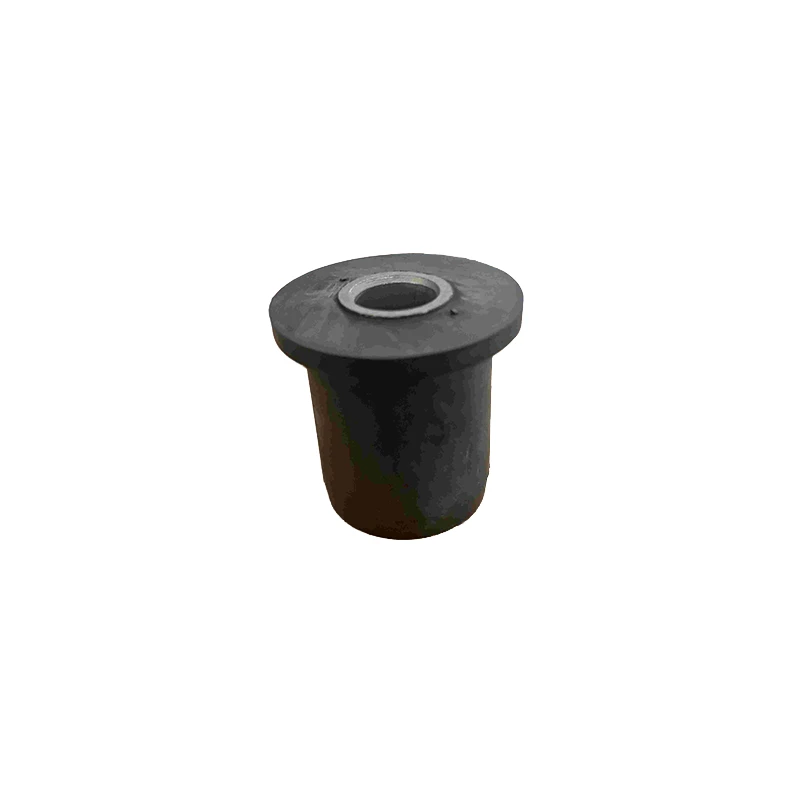
Rubber bushings are key damping components in automotive chassis, primarily functioning to connect and buffer vibrations between the vehicle body and chassis components, improving handling stability and ride comfort. They utilize the elastic properties of rubber to absorb road impacts, isolate noise and vibration (NVH), and allow for a degree of motion decoupling.
Core Technical Points
Optimization of Static/Dynamic Stiffness Ratio
Static Stiffness: Ensures the geometric stability and handling precision of the vehicle during cornering and acceleration.
Dynamic Stiffness: Used to filter high-frequency road vibrations, improving comfort.
High-quality bushings require an ideal match of "high static stiffness and low dynamic stiffness," an indicator known as the "static/dynamic stiffness ratio," a core parameter for evaluating chassis quality.
Rubber Formulation Design: Leading manufacturers customize their rubber systems by controlling the vulcanization crosslinking density and molecular chain length, enabling the bushings to provide strong support under low-frequency, large displacement conditions while maintaining a soft, damping effect under high-frequency, micro-vibrations.
Structural Design and CAE Simulation: Finite element simulation (such as ABAQUS) using a nonlinear hyperelastic constitutive model is employed to digitally twin-simulate the bushing's deformation behavior under multi-axial loads, optimizing its 3D topology and flow channel design to avoid stress concentration.
Manufacturing Process and Assembly Technology:
Zero-gravity Assembly:The manufacturer uses a "zero-gravity" state, simulating the vehicle's landing posture, to tighten bolts, ensuring the bushing is not subjected to pre-stressing or torsion due to the vehicle's weight, thus extending its lifespan.
High-Precision Mold Machining: CNC micron-level compensation is used to sculpt the mold cavity, eliminating residual stress from vulcanization molding and ensuring consistent performance.
Fatigue Durability and Testing Verification: The bushing must withstand millions of high-cycle fatigue impact tests, including rigorous environmental tests such as heat aging, ozone resistance, and three-channel composite loads. Mass production only begins after fully meeting the OEM's standards.
Diversity of Materials and Frame Structures: Bushings can be divided into pure rubber, single/double/multi-frame structures, and hydraulic bushings, etc., to meet the stress requirements of different positions (such as control arms and subframes).