

In various industrial and mechanical applications, the ability to handle sudden shocks is crucial for the reliability and longevity of equipment. Rubber shock blocks play a vital role in this regard, acting as a buffer to absorb and dissipate the energy generated by sudden impacts. As a supplier of high - quality rubber shock blocks, I have witnessed firsthand the remarkable performance of these components in responding to sudden shocks.
The Mechanics of Rubber Shock Blocks
Rubber is a viscoelastic material, which means it has both viscous and elastic properties. When a sudden shock is applied to a rubber shock block, the elastic property allows the rubber to deform rapidly. This deformation is a key mechanism in absorbing the shock energy. The rubber stretches or compresses in response to the force, storing the energy within its molecular structure.
The viscous property of rubber comes into play during the dissipation of the stored energy. As the rubber deforms, internal friction occurs between its molecules. This friction converts the mechanical energy of the shock into heat energy, which is then gradually released into the surrounding environment. This process of energy conversion and dissipation is what enables rubber shock blocks to effectively reduce the impact force on the connected equipment.
Factors Affecting the Response of Rubber Shock Blocks to Sudden Shocks
Material Composition
The type of rubber used in the shock block significantly affects its performance. Different rubber compounds have varying degrees of elasticity and viscosity. For example, natural rubber offers high elasticity, which allows it to deform easily under shock. This makes it suitable for applications where large - scale deformation is required to absorb the shock energy. On the other hand, synthetic rubbers like neoprene or nitrile rubber may have better chemical resistance and can be used in more harsh environments. They also have different levels of damping properties, which influence how quickly the shock energy is dissipated.

Shape and Design
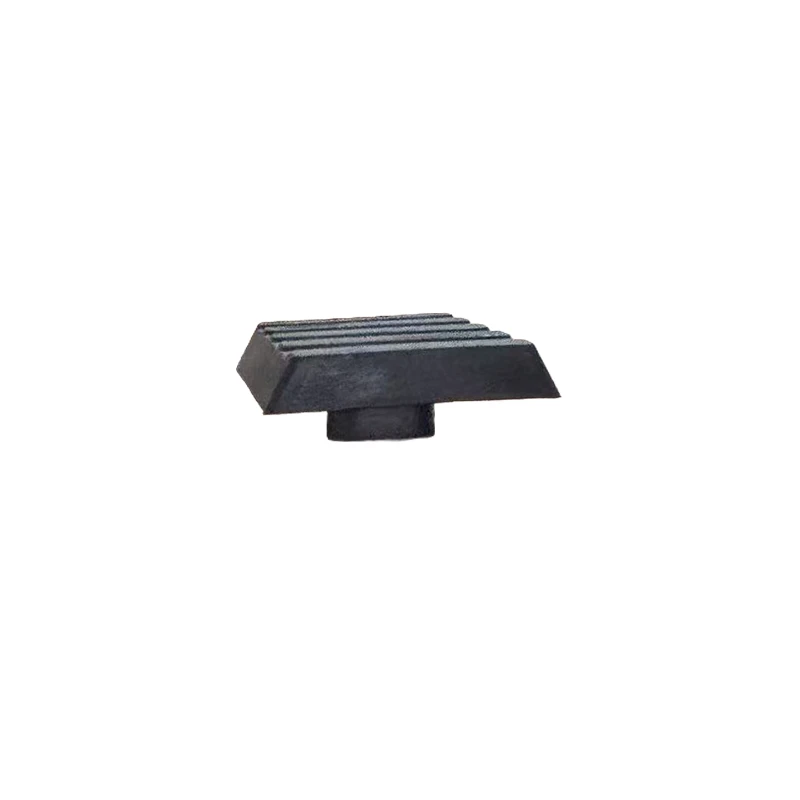
The shape of the rubber shock block is another important factor. A well - designed shock block can distribute the shock force evenly across its surface. For instance, a cylindrical shock block may be more suitable for applications where the shock is applied axially, while a rectangular block can be better for multi - directional shocks. Additionally, the internal structure of the shock block, such as the presence of voids or channels, can enhance its energy - absorbing capacity. These voids can allow the rubber to deform more freely, increasing the amount of energy that can be stored and dissipated.
Pre - loading
Pre - loading the rubber shock block can also affect its response to sudden shocks. When a shock block is pre - loaded, it is under a certain amount of stress before the shock occurs. This pre - stress can change the stiffness of the rubber and its deformation characteristics. In some cases, pre - loading can improve the shock - absorbing performance by ensuring that the rubber is already in a state of partial deformation, allowing it to respond more quickly to the shock.
Applications of Rubber Shock Blocks and Their Shock - Response
Automotive Industry
In the automotive industry, rubber shock blocks are widely used in various components. For example, Rubber Mount for Auto Chassis helps to isolate the chassis from the engine vibrations and road shocks. When a vehicle hits a pothole or an uneven surface, the rubber shock blocks in the suspension system deform to absorb the sudden impact. This not only provides a smoother ride for the passengers but also protects the vehicle's components from damage.
Industrial Machinery
Industrial machinery often experiences sudden shocks during operation. Rubber shock blocks are used to reduce the impact on the machinery and prevent damage to sensitive components. For example, in a stamping machine, a Rubber Buffer Block can be installed at the end of the stroke to absorb the shock when the machine reaches its limit. This helps to extend the lifespan of the machine and improve its overall performance.
Electrical Equipment
In electrical equipment, rubber shock blocks are used to protect against vibrations and shocks. For instance, in a generator, Rubber Limit Pad can be used to limit the movement of components and absorb any sudden shocks that may occur during startup or operation. This helps to ensure the stability and reliability of the electrical equipment.
Testing and Quality Assurance
As a rubber shock block supplier, we conduct rigorous testing to ensure the quality and performance of our products. We use advanced testing equipment to simulate sudden shocks and measure the response of the shock blocks. This includes testing for factors such as maximum deformation, energy absorption capacity, and durability.
We also perform chemical and physical property tests on the rubber materials to ensure that they meet the required standards. For example, we test for hardness, tensile strength, and tear resistance. By conducting these tests, we can guarantee that our rubber shock blocks will perform effectively in real - world applications.
Advantages of Our Rubber Shock Blocks
Our rubber shock blocks offer several advantages over other products in the market. Firstly, we use high - quality rubber materials that are carefully selected for their shock - absorbing properties. This ensures that our shock blocks can effectively handle sudden shocks and provide long - term performance.
Secondly, our shock blocks are designed with precision. We take into account the specific requirements of different applications and design the shape and structure of the shock blocks accordingly. This allows for optimal energy absorption and distribution.
Finally, we offer customization services. We understand that different customers may have different needs, so we can customize the rubber shock blocks in terms of size, shape, and material composition. This ensures that our customers can get the most suitable shock blocks for their applications.
Contact Us for Your Rubber Shock Block Needs
If you are in need of high - quality rubber shock blocks, we are here to help. Our team of experts can provide you with detailed information about our products and assist you in selecting the most appropriate shock blocks for your specific application. Whether you need Rubber Damper Pad, Rubber Buffer Block, Rubber Limit Pad, Rubber Shock Block, or Rubber Mount for Auto Chassis, we have the solutions for you.
Don't hesitate to contact us to start a procurement discussion. We look forward to working with you to meet your shock - absorbing needs.
References
- "Engineering with Rubber: How to Design Rubber Components" by George Kraus
- "Handbook of Elastomers" edited by Henry H. Kausch
- "Rubber Technology" by Maurice Morton